
“Am I Getting a Fair Deal?” How to Spot Hidden Errors and Overcharges on Your Car Contract
If you are staring at a dealer worksheet, quote, or lease proposal and asking yourself, “Am I getting ripped off?” or “Is there something wrong with these numbers?”—trust your gut.
Deal sheets are structured to make line-item fee bloat, marked-up interest rates, and subtle math errors look official and non-negotiable. Most buyers only look at the monthly payment, missing thousands of dollars in hidden overcharges buried in the fine print.
The quickest way to know if your deal is fair isn’t guessing—it’s running a line-item audit against real regional market data and state tax rules.
3 Major Red Flags on Dealer Quotes
- The Tax Calculation Trap: Dealers frequently calculate state sales tax on the full vehicle price without subtracting your trade-in allowance first—costing you hundreds in illegal tax overcharges in states that allow trade-in tax credits.
- Market Value Inflation: The “Asking Price” or “Worksheet Price” is rarely fair market value. If the base selling price isn’t benchmarked against regional sales data, you start negotiations from an inflated baseline.
- The Rate Markup: Dealerships routinely mark up financing interest rates (APR) or lease Money Factors above bank tier-1 benchmarks, adding thousands in unnecessary interest over the life of the loan.
Real Audit Case Study: How a Buyer Caught a $3,381 Overcharge
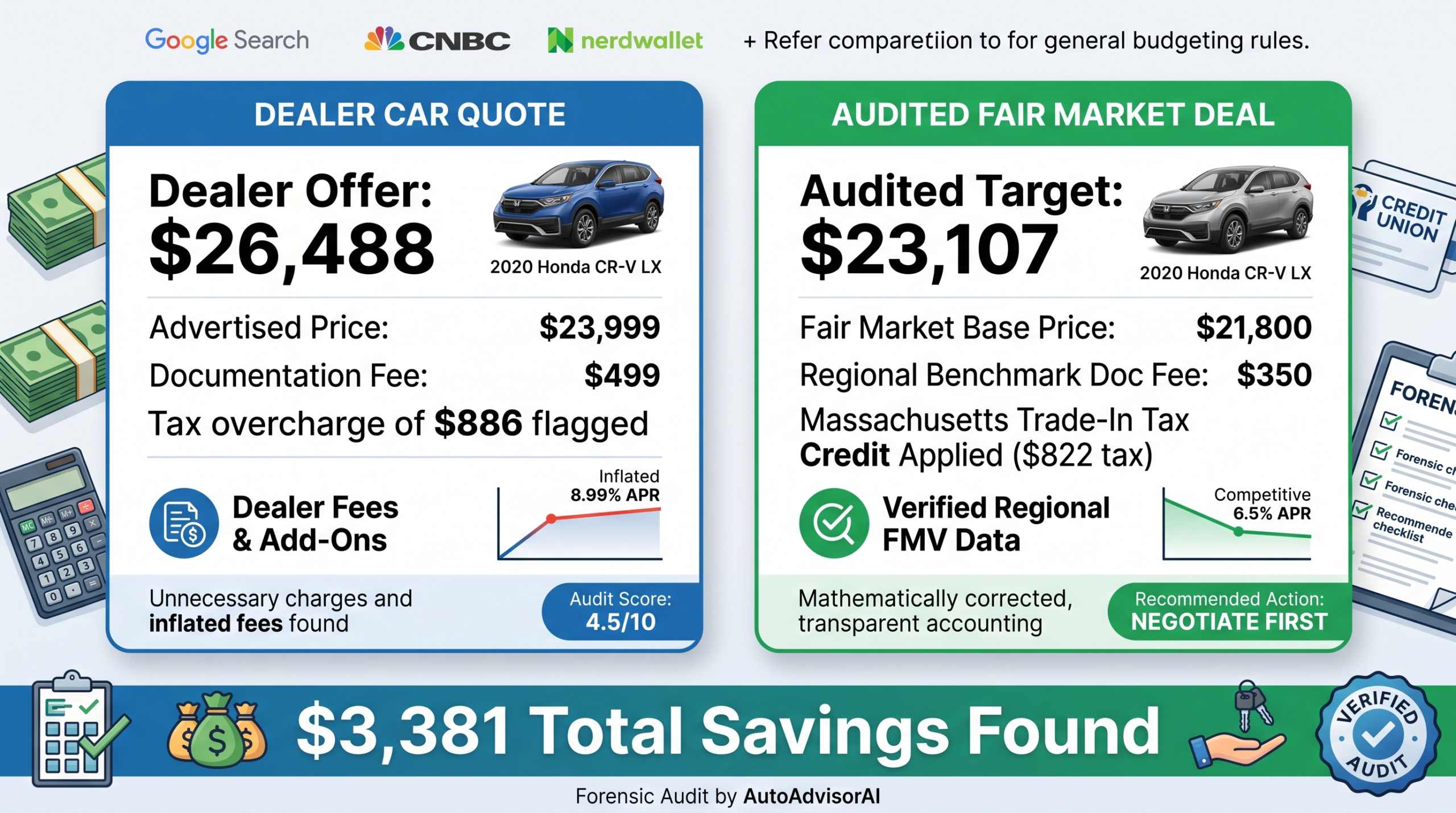
When one buyer asked if their dealer quote on a 2020 Honda CR-V LX (28,669 miles) was a good deal, an AutoAdvisorAI forensic audit revealed $3,381 in unnecessary charges hidden inside a single worksheet:
| Financial Metric | Dealer Worksheet Offer | AutoAdvisorAI Target Benchmark | Total Consumer Savings |
|---|---|---|---|
| Advertised Base Price | $23,999 | $21,800 | $2,199 |
| Documentation Fee | $499 | $350 (Regional Benchmark) | $149 |
| Government Reg & Title | $135 | $135 | $0 |
| Calculated Sales Tax | $1,855 | $822 (Legally Corrected) | $1,033 |
| Gross Out-The-Door (OTD) Price | $26,488 | $23,107 | $3,381 |
| Net Financed Balance (after $11k trade/down) | $15,488 | $12,107 | $3,381 |
The 3 Major Overcharges Uncovered
1. Failure to Apply State Trade-In Tax Credit ($886 Error)
In Massachusetts (and many other states), trading in a vehicle reduces the taxable baseline of the purchase. The buyer was trading in a 2012 Toyota Corolla valued at $9,000.
- The Dealer’s Math: The dealership calculated 6.25% sales tax on the pre-trade vehicle price ($23,999 base + $499 doc fee = $24,498 * 6.25% = $1,531.13) and added unexplained fees, quoting $1,855 in total tax.
- The Correct Math: The $9,000 trade allowance must be subtracted first ($23,999 base + $499 doc fee – $9,000 trade = $15,498 taxable base). At 6.25%, the legal sales tax is $968.63 on the dealer’s price, or $822 on the target FMV price. The dealer’s sheet contained an immediate $886 sales tax overcharge.
2. Base Price Inflation Above FMV
The advertised base price of $23,999 was more than 10% above the regional Fair Market Value ($21,800) for a 2020 CR-V LX with 28,669 miles.
3. Finance Interest Rate Markup
The dealer quoted an interest rate of 8.99% APR over 60 months. Compared to the prevailing 6.50% credit union benchmark for Tier-1 credit on used vehicles, this rate markup represented an extra $1,050 in interest charges over the life of the loan. Correcting the price, tax, and interest rate lowered the monthly payment from $321/month down to $237/month.
How Purchase and Lease Audits Process Your Data
AutoAdvisorAI handles audits across two execution pathways:
Option A: Document Upload Audits (Worksheets, Window Stickers, Buyer’s Orders)
If you have a physical quote or digital PDF:
- Optical Extraction: Computer vision models extract the VIN, mileage, selling price, itemized fees, and financing terms directly from uploaded images or documents.
- Document Cross-Matching: The audit cross-references line items across uploaded documents (e.g., comparing a Dealer Worksheet against a CarFax or Window Sticker) to catch discrepancies.
- Compliance Checks: Evaluates state-specific tax laws, doc fee benchmarks, and mandatory vs. non-mandatory registration charges.
Option B: Data-Input Audits (No Documents Uploaded)
If you are negotiating over the phone or online without a formal paper quote:
- Algorithmic Fair Market Valuation: Generates an FMV baseline using year, make, model, trim, mileage, and vehicle condition inputs.
- Lease Structure Checks: For lease deals, the system audits Adjusted Capitalized Cost, Money Factor (APR equivalent), Residual Value percentage, and acquisition fees to identify hidden padding.
What Is Included in a Full Forensic Audit Report?
When an audit is complete, the platform generates a comprehensive report containing:
- Overall Audit Score (10-Point Scale): An objective summary of the deal quality based on price, fee bloat, title history, financing terms, and document readability.
- Side-by-Side Financial Table: Direct comparison between the Dealer’s Offer and the AutoAdvisorAI Target Benchmark.
- Copy-and-Paste Negotiation Scripts: Exact text customized with your specific vehicle details, target OTD numbers, and legal tax citations to send directly to dealership management.
- F&I & Fee Objection Playbook: Written responses to overcome common dealer objections regarding administrative fees, market adjustments, and finance rate markups.
- Surgical Mechanical Pre-Purchase Inspection Guide: Tailored checklist items for an independent mechanic based on known powertrain vulnerabilities (such as CVT fluid checks or turbocharger inspections).
How to Negotiate Using Your Audit Results
When presenting audit findings to a sales manager, keep the conversation focused on objective numbers and state compliance rather than emotion.
Sample Opening Counter-Offer Script
“Hi Tasca Toyota Boston Sales Team, I am prepared to move forward with the purchase of the 2020 Honda CR-V LX today, but we have a major discrepancy on the worksheet that must be corrected before I sign.
First, the sales tax calculation of $1,854.69 is incorrect. In Massachusetts, the $9,000 trade-in must be deducted from the taxable base, which brings the correct tax down to $968.63 on your numbers.
Second, based on regional market data for this LX trim, the fair market value is $21,800. I am offering a fair, competitive Out-The-Door price of $23,107, which includes the corrected tax, registration, and a standard $350 doc fee. If we can agree to these terms, I will sign the paperwork immediately.”
Frequently Asked Questions
Not sure if your worksheet math is wrong?
Read our real CR-V audit case study.
What is an Out-The-Door (OTD) price?
An Out-The-Door (OTD) price is the final, total balance required to purchase a vehicle, including the base vehicle price, documentation fees, government registration charges, state sales tax, and any dealer-installed options.
What is a reasonable dealer documentation fee?
While documentation fees vary by state law (some states cap them at $100–$200, while uncapped states can exceed $800), $300 to $350 serves as a standard national benchmark for reasonable dealer administrative overhead.
How do trade-in sales tax credits work?
In most U.S. states, when you trade in a vehicle at the same dealership where you purchase another, state law permits you to pay sales tax only on the net difference between the new vehicle price and the trade-in allowance.
Audit Your Purchase or Lease Deal Before You Sign
Don’t leave thousands of dollars on the table due to unverified math or hidden fee bloat. Run your purchase paperwork or lease proposal through AutoAdvisorAI to receive an instant forensic breakdown.
Start Your Purchase Deal Audit | Start Your Lease Deal Audit